

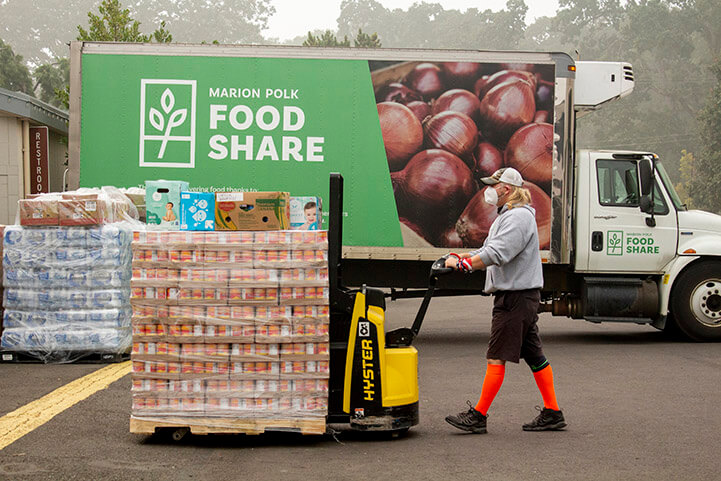
In 2023, Marion Polk Food Share distributed a record-high 10 million pounds of food, providing $14 million in relief to 18,000 households monthly, another record high.
In an interview with the Salem Business Journal, Marion Polk Food Share President and CEO Rick Gaupo discussed the changing landscape of food banks, economic trends causing record hunger levels, and Food Share’s impact on homelessness and hunger, along with ways for individuals and businesses to contribute.
What food do you picture?
A person who shows up to a Marion Polk Food Share food bank, known as a neighborhood pantry location, will receive a three-to-five-day food box filled with nutritious meals that will allow the person and their family to work, learn, and thrive. Salem is home to over 20 of the 50-plus pantries that operate out of churches and nonprofits in 18 Marion Polk communities, all run by volunteers.
Old-fashioned ideas about food banks are a thing of the past. “We imagine food banks filled with cans of processed food and hamburgers, almost all of them damaged and dented,” Gaupo said. “We’re not talking about packaged macaroni and cheese. We’re talking about what everyone buys at the supermarket.”

Marion Polk Food Share stocks 40% of their food bank supply with fresh and frozen foods that mirror the same fruit and vegetables, meats, milk, and dairy products in season at your local grocery store. The other 60% is quality products made possible by their large-scale donation system to prevent food waste and maximize community collaboration.
Donating doesn’t equate to causing harm. “The food production system has intentionally created surpluses. A farmer has to grow more than they need to meet their contract quota,” Gaupo said. “A grocery store must have a surplus available to avoid selling the last item. We collect the surplus.”
Marion Polk Food Share is regional, meaning it obtains 70% of its supply from farms, food processors, grocery stores across the region, and even individuals. Government assistance food makes up the rest.
Gaupo shared stories of fabulous community partnerships, such as Top Hat Mushrooms, which generously donated pallets of shiitake mushrooms. These mushrooms, valued at $8 per pound in local grocery stores, were just one example, alongside other stories of semi-truck surprise deliveries.
It moves me to think of someone who came to their local food bank and said, “Oh my gosh! I can put shiitake mushrooms in my stir-fry tonight!” Gaupo said. “They walk in and see an incredible array of meats. Or they bring us a truck full of milk, dairy, and yogurt. It’s all thanks to generosity.”
The quality food that is collected is estimated at wholesale value, which Gaupo points out the $14 million from 2023 alone would be even higher at its retail value.
Whose faces do you picture?
“We believe food banks are primarily focused on feeding the homeless or unhoused,” Gaupo said. “But between 75% and 85% of the people served already live in their homes—they are not predominantly homeless—and are trying to remain there.”
The changing landscape of food banks includes reducing the social stigma surrounding people seeking help to ease debt and budget burdens.
To understand the economic reality of hunger, Gaupo draws on the saying: “When you are hungry, you have one problem to solve. If you are full, you have many.”
Marion Polk Food Share delivered more food to a record number of people in 2023 because inflation has made food and housing costs 20% higher than before the pandemic. Pandemic government assistance safety measures like SNAP, child tax credits, unemployment assistance, mortgage and renter protections, and business payroll protections have now gone away, adding to record-high numbers.
Gaupo wants the community to understand the value of Marion County’s Food Share initiative as a measure to prevent homelessness. There are greater obstacles to obtaining assistance with rent, childcare, or a higher salary. “Food banks are a low-cost program; if you come to a pantry, we believe you need help,” she said.
Another lesser-known aspect of Marion County Food Share is how it supports other faces, including nonprofits like ARCHES, Union Gospel Mission, Simonka Place, and Church in the Park. This support is achieved through food delivery donations, providing budget relief, and strengthening their capacity.
What community do you picture?
Gaupo commented that people might think Food Share simply solves the hunger problem. Instead, he said, they seek to make the greatest impact with the most passionate vision the community allows.
Their vision for impact continues to innovate and reach beyond the food bank model. They have congregate meal sites where people come together to share meals, over 50 Marion Polk community gardens to grow food, Meals on Wheels for seniors and disabled adults in Salem and Keizer, a Senior Grocery Program that delivers monthly groceries, and a six-acre urban Youth Farm in Salem in partnership with Chemeketa Community College and Oregon State University.
Gaupo wants everyone, both individuals and businesses, to know that they can significantly contribute to combating hunger in the community by donating money, time, and food.
The vast majority of Marion Polk Food Share’s budget comes from the support of donors who contribute between $10 and $25 a month through the Support Program. Gaupo said this reminds her of the idea that we stay nourished by eating small meals a day, seven days a week, and the same principle applies to fighting hunger.
But a fourth way that is often overlooked is to vote for politicians who will elevate the concern for hunger in our community.
Gaupo suggested asking politicians: “Will they support hungry children in schools so they can focus on learning? Will they ensure my employees can come to work without hunger being their main concern?”
Food Share leverages community goodwill to combat hunger.
“What kind of community do you want to live in?” Gaupo asked. “Because nothing good happens when you’re hungry.”
Visit https://marionpolkfoodshare.org for a list of meal sites, learn how to donate food, volunteer opportunities, and ways to give.
