
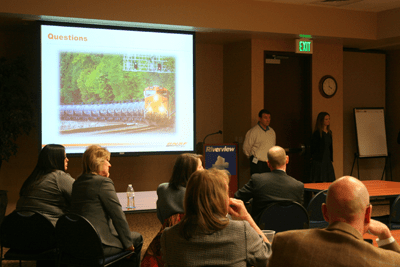
Here are ten questions and answers from the meeting (please keep in mind that these questions and answers are not verbatim):
Q: Who is legally responsible for damage and clean-up in the event of a train derailment?
A: BNSF is the responsible party. A damaged site must be restored to pre-derailment conditions.
Q: What does the forecast for rail traffic look like?
A: Rail traffic fluctuates with the economy. In 2006, rail traffic was at its peak. BNSF anticipates traffic to increase in the coming years regardless of regional oil and/or coal projects.
Q: What investments is BNSF making in Clark County?
A: There are several ongoing projects locally: BNSF is moving switches to strategic spots along Highway 14; adding a new crossing in Camas; removing bottlenecks by 11th Street in Vancouver while introducing quiet zones; in 2015, BNSF will connect additional tracks between Washougal and Skamania.
Q: Is BNSF doing anything to support or help communities that are actively trying to promote development?
A: There is a division of BNSF that acts as a public/private organization, working together with communities to promote economic development.
Q: What is BNSF’s stance on at-grade crossings?
A: BNSF tries to avoid them when possible.
Q: What does the process/timeline look like when a community wants to separate a rail line?
A: It is a long process and can take years, “but we want to work with communities.” BNSF is trying to change how railroad companies have acted in the past – the “we were here first” attitude.
Q: Does the stable elevation of the rail line along Highway 14 make it attractive asset to BNSF?
A: Yes, but BNSF can utilize its line through the passes if needed. It depends on customer demand. Overall, the line that runs along Highway 14 is attractive for many reasons.
Q: What were the conditions that led to the crude oil train derailment and explosion in North Dakota late last year?
A: That derailment stemmed from a grain train derailment caused by a broken axle.
Q: BNSF says it is “aggressively pushing” government regulators to back new standards requiring older tank cars to be modified or junked. What does “aggressively pushing” mean?
A: BNSF is lobbying the government. Next generation tank cars are more accident-resistant and would help improve industry safety.
Q: How much does it cost to retrofit an existing tank car for improved safety? What is the cost of a “next generation” tank car?
A: Modifying an existing tank car would cost approximately $60,000. New tank cars cost anywhere between $125,000 and $200,000.
{jathumbnail off}